 Tariffs API
U.S. Import Tariffs by HTS Code and Country
Instantly look up import duties, trade agreement rates, and extra tariffs for any product and origin, or integrate via API.
One Question, One API Call
Give the API an HTS code and a country of origin. You get back the full tariff picture: base duty (general or special under a trade agreement), any applicable additional duties, and Chapter 99 references when relevant.
Inputs
- HTS code (e.g. 8541.10.00)
- Country of origin (e.g. CN, MX)
Outputs
- Base duty (general or special)
- Trade agreement treatment
- Additional duties (e.g. Section 301)
- Chapter 99 references and resolution
Example: HTS 8541.10.00 from China
For a product classified under 8541.10.00 (e.g. certain electronic products) from China, the API returns the base general or special rate plus any additional duties that apply to that origin. When Section 301 applies, you get a transparent breakdown: base duty and additional ad valorem (or reference to the Chapter 99 line). No invented rates—when a measure points to Chapter 99, you can request resolution so the API looks up the numeric rate in our database.
Try it in the Tariff Calculator or call the resolve endpoint in the API.
HTS Codes & Trade Agreements
U.S. import tariffs depend on the HTS code (Harmonized Tariff Schedule) and the country of origin. Tariffs API resolves this so you get one clear answer per product and origin.
- HTS codes — We use official HTS structure and inheritance so subheadings resolve to the correct duty. Browse the HTS index to look up codes and see rates by country.
- Country-specific tariffs — General (Column 1) vs special (trade agreement) rates depend on origin. The API returns the applicable rate for the country you pass.
- Trade agreements — USMCA, Korea (KORUS), Australia, and other FTA/preference programs are reflected in special rates. We apply the right treatment so you don’t have to look it up manually.
- Section 301, Section 232, IEEPA — Additional duties and restrictions are returned as separate measures with clear labels. See Section 301, Section 232, and IEEPA for background.
- Chapter 99 — Many additional duties reference Chapter 99 (e.g. “See 9903.91.05”). We can resolve those to numeric rates when the line exists in our database. Details: Chapter 99.
Why Tariffs API
Static HTS tables and spreadsheets tell you the rate for a single line—they don’t resolve which rate applies for a given country or how base duty, trade agreements, and additional measures combine. Tariffs API does that resolution for you and exposes it via API and tariff calculator.
Resolution logic
HTS inheritance, country-specific special rates, and additional measures are applied in one call—no manual cross-referencing.
Transparency
Responses break down base duty, trade agreement, and additional duties separately so you know why a tariff applies.
Programmatic access
Integrate tariff resolution into calculators, ERPs, and trade compliance tools via a single resolve endpoint.
Built for developers building tariff calculators, procurement and sourcing teams, and trade compliance tools. Browse HTS codes, run a calculation, or read the API docs.
US tariff data is complex and constantly changing 📊
Keeping up with US tariff changes is challenging. The USTR and CBP websites are hard to navigate, and updates can be buried in complex regulatory notices. Our API monitors official US sources and news outlets 24/7, extracting and validating tariff changes so you don't have to. Get instant access to accurate US tariff rates, Section 301 duties, antidumping measures, and tariff-related news - all in one place. Pro members can access our curated news feed through the API to be the first to know about changes that impact their business.

Explore U.S. Tariff Data
Browse the HTS index to search by HTS code, view detailed rates by country, and see trade agreements and additional duties at a glance.
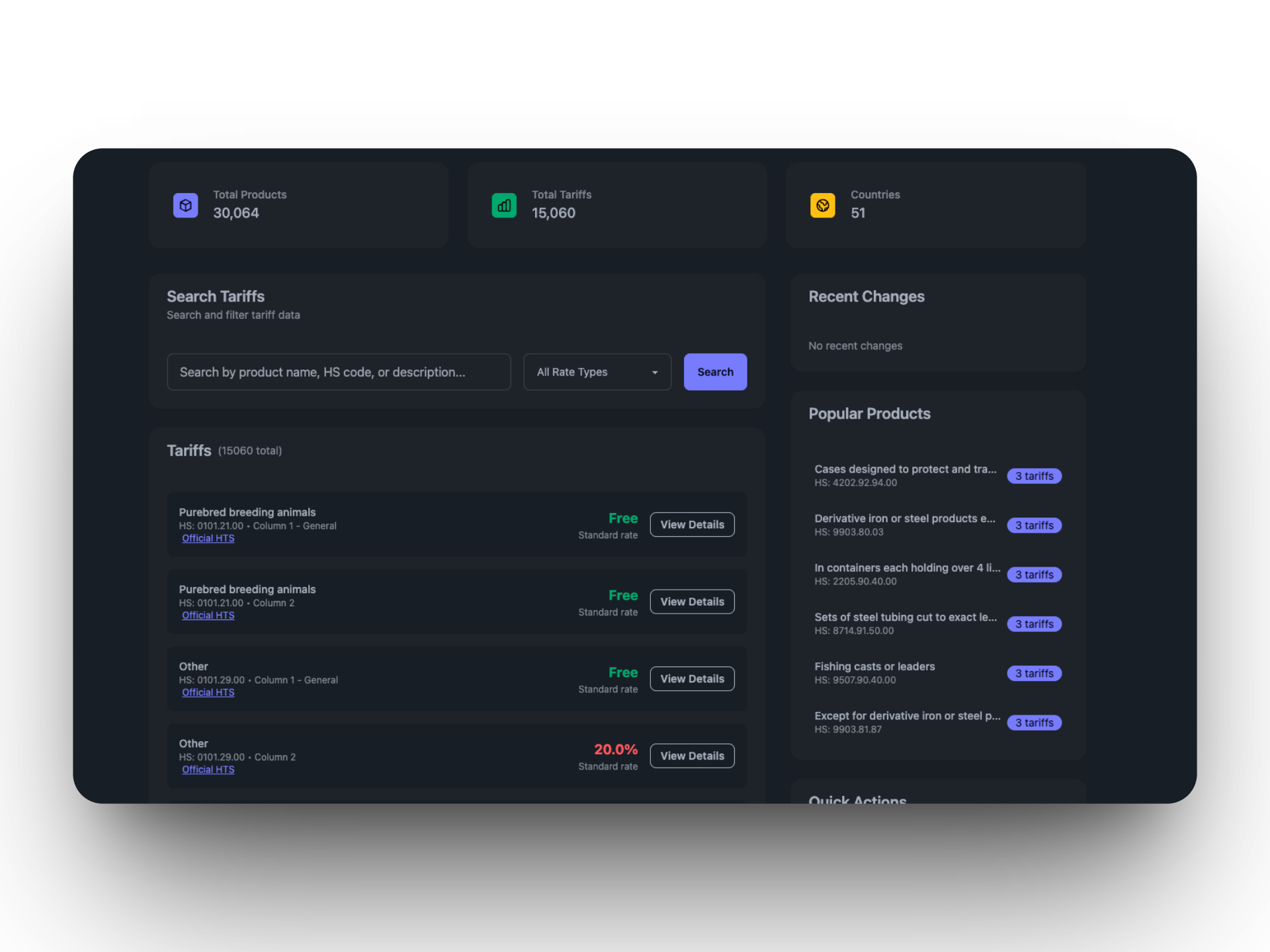
Ready to explore tariff data?
Search thousands of products and view detailed tariff information
Smart Search
Find products quickly with our intelligent search and filtering system
Detailed Rates
View comprehensive tariff information including per-unit and percentage rates
Real-time Data
Access up-to-date tariff information with official HTS source links
Latest Updates
Global Tariff News
Stay informed with the latest changes in global trade and tariff policies
Subscribe to get the latest newsEcuador hikes tariffs on Colombian imports to 50 percent starting March 1 - Al Jazeera
The new announcement from Quito follows an initial 30 percent tariff imposed by the Andean nation in early February.
Trump administration faces first big tariff refund court deadline on Friday - CNBC
Trump's DOJ has until Friday to decide on moving a tariff refund case to the Court of International Trade, the first deadline since the Supreme ...
Okay, What's Actually Happening with the Tariffs? - The Contrarian
So the president went to a different legal authority, declared a balance of payments crisis, and immediately imposed a 10% across-the-board tariff On ...
Tariffs are raising costs for small businesses and farmers, VA hospitals are understaffed, and ...
Tariffs are raising costs for small businesses and farmers, VA hospitals are understaffed, and ICE agents spent weeks hurting communities across ...
Trump's tariffs are a backdoor tax that cost New Yorkers over $13 billion. On behalf of small ...
Susan Woyshner Charging tariffs is a macroeconomic "bad" (overall higher costs/inflation) and Importers usually pass tariff costs to consumers, ...
U.S. Import Price Dynamics Following the 2025 Tariffs - Federal Reserve Bank of St. Louis
Tariffs and Import Prices. When tariffs are imposed on imports of a particular good from a particular country, demand for those imports falls. Foreign ...
Flexible API Pricing Plans
Choose the plan that best fits your needs and scale your access to the latest tariff and trade data.
Free Tier
Perfect for exploring the latest tariff data through our dashboard.
- Access to UI dashboard with latest tariff changes
Basic Tier
Ideal for small businesses and startups.
- 10,000 API calls/month
- HTS code lookup & resolution
- Chapter 99 calculations
- Real-time tariff updates
- Tariff news API access
- UI dashboard access
Professional Tier
Ideal for growing businesses with advanced needs.
- 50,000 API calls/month
- Everything in Basic, plus:
- Country-specific HTS resolution
- Bulk API endpoint
- MCP server access New
- Priority rate limits
- Priority support
Tariff resolution
Frequently Asked Questions
Plain-English answers about HTS codes, trade agreements, and programmatic tariff lookup.
An HTS (Harmonized Tariff Schedule) code is a number that classifies goods for U.S. customs. It determines which duty rate applies. Codes are hierarchical (e.g. 8541 is a heading; 8541.10.00 is a subheading). Tariffs API uses the full code and country of origin to return the applicable rate. You can browse codes in our HTS index.
Countries with a U.S. trade agreement or preference program often get a lower “special” rate instead of the general rate. The API takes the country of origin you pass and returns the correct rate—e.g. USMCA for Canada/Mexico, KORUS for Korea, and other FTAs. You get one resolved rate per HTS and country.
Section 301 refers to additional U.S. tariffs imposed on certain products from specific countries (notably China) following trade investigations. These appear as extra duties on top of the base HTS rate. Tariffs API returns them as separate measures with clear labels. See our Section 301 explainer for more.
Yes. The resolve endpoint accepts an HTS code and country of origin and returns base duty, trade agreement treatment, and any additional duties (e.g. Section 301, 232). You can build calculators, spreadsheets, or compliance tools on top. For a no-code check, use the Tariff Calculator.
Section 232 covers tariffs based on national security (e.g. steel and aluminum). IEEPA relates to sanctions and other restrictions. Tariffs API includes these when they apply to a given HTS and origin. Details: Section 232, IEEPA.
Access Tariffs Data via API
Integrate HTS codes, tariff rates, and trade data into your applications
Built for importers, exporters, and trade professionals who need programmatic access:
- Real-time tariff rate lookups
- HTS product and classification data
- RESTful JSON API with clear documentation
Unlock Global Trade Insights with TariffsAPI
Explore real-time tariff data and analytics to stay ahead in the global market. Access our comprehensive dashboard with the latest US tariff information.